
August 20, 2026
How can we actively help shape the future?
Futurist Max Thinius invites you to Erfa 2026 on September 30 for a discussion on new technologies, values, structures, and ways of thinking.

Knowledge for Practical Application
A significant portion of technical innovations is based on novel materials possessing new properties. These materials are expected to withstand increasingly severe stresses. However, novel materials also present new challenges, often with limited empirical data available. Whether it is the development and testing of materials, ensuring quality standards for technical materials, or conducting a supplier audit – IGR's expertise encompasses:
How can we actively help shape the future?
Futurist Max Thinius invites you to Erfa 2026 on September 30 for a discussion on new technologies, values, structures, and ways of thinking.

The current status of the presentation program for the IGR Knowledge Exchange 2026 is available: Look forward to practical technical presentations, including those from the Federal Institute for Occupational Safety and Health on PFAS, as well as from Siemens, Clariant, Bilfinger, and Emerson.
The program is further enhanced by a presentation from the renowned futurist Max Thinius and prominent exhibitors such as KSB, TÜV Hessen, Emerson, and Pepperl+Fuchs.

Key Topics: Resilient Production Processes, Targeted Resource Utilization, and New Digital Business Models
Mörfelden/Walldorf. How do plant operators transition Artificial Intelligence from the pilot phase into production? Answers will be provided at a knowledge exchange event on September 30 / October 1, 2026, at the Bürgerhaus in Mörfelden/Walldorf. Discussions will focus on how AI contributes to purposefully driving innovation, future-proofing processes, and enhancing customer centricity.

This year, IGR is once again inviting participants to its knowledge exchange event at the Bürgerhaus in Mörfelden-Walldorf. Under the central theme of "Artificial Intelligence in the Process Industry," there will be numerous interesting expert presentations from the fields of Mechanical and Process Engineering, Process Safety, EMR, and Materials Technology.

Guideline T 002 has been republished and available since October 2025 in the BG RCI download center!

As always, a concise and engaging welcome was delivered by Dr. Werner Sievers, Chairman of the IGR Board. Subsequently, approximately 70 interested 'new' and 'long-standing' employees from IGR member companies received information for orientation within the IGR Portal.

Dear IGR Members and Interested Parties!
We extend our gratitude to all member companies and experts who, once again this year, have contributed to preserving, sharing, and collectively advancing the technical expertise of IGR e.V.

New regulatory requirements, international competitive pressure, and decarbonization were among the dominant themes.
On September 4 and 5, the Interessengemeinschaft Regelwerke Technik (IGR) e.V. hosted its Expert Exchange publicly for the first time. This biennial event is firmly established within the chemical and pharmaceutical industry. Over 120 participants gathered at the Kultur- und Tagungszentrum Mörfelden-Walldorf for the occasion. This time, the industry utilized the platform for an intensive exchange on the challenges and opportunities presented by global transformation.

Our long-standing colleague Michael Michalski, who was actively involved with IGR for many years, passed away on July 13, 2024, after a short, severe illness.
Throughout his professional life, Michael Michalski was dedicated to the diverse challenges of safety engineering. After earning his diploma in chemical engineering in 1984, he worked for various smaller engineering firms specializing in this field. Building on this solid foundation, Michael moved to Frankfurt in 1996 and became the Incident Officer at Hoechst AG. In 1998, he transitioned to Clariant, where he managed plant safety matters for Clariant Germany, before joining Siemens Process Safety as a Senior Expert in 2010.
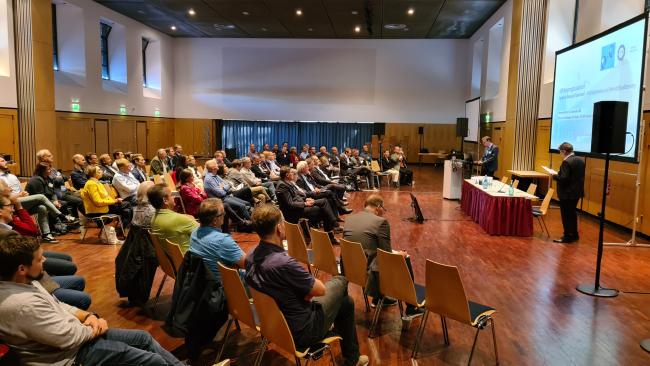
At the IGR Technical Experience Exchange on September 22 and 23, 110 specialists discussed modular plant concepts and algorithms for new process workflows, as well as other topics related to digitalization in the process industry. The experience exchange targets professionals responsible for planning, engineering, and production, connecting the expertise of members from various companies across operational boundaries. This year's main theme was: "Modular Affinities – The Process Engineering World in Algorithmic Upheaval?"
IGR monitors the development of various additively manufactured components and/or materials (cf. Additive Manufacturing, AM). The objective is to sufficiently understand their highly complex properties and to facilitate their application for IGR members through current knowledge. Currently, the altered corrosion properties of stainless steels produced by additive manufacturing are being investigated. To this end, IGR experts regularly attend scientific conferences and specialized events.
In the chemical industry, half-pipe coils are sometimes welded to vessels for cooling or heating media. Corrosion frequently occurs on the media-contacting side in the vicinity of the half-pipe weld seam. Gaps can form and stresses can be introduced during welding operations. IGR has developed a guideline for its members that provides information on the influence of various corrosive media. It assists in ensuring corrosion-resistant weld seams under all conditions.
The IGR Competence Center for Materials Technology actively participates in the working groups of the Society for Corrosion Protection (GfKORR). This ensures that IGR member companies consistently receive the latest information on new research projects at universities and institutes. Conversely, IGR contributes its positions to these working groups. An example is the project-accompanying committee for a rapid corrosion risk test (KorroPad method), cf. article in CHEManager.
Rouging, the reddish-brown discoloration of stainless steel surfaces, occurs in high-purity water at temperatures above 60 °C. This phenomenon is not corrosion but rather a characteristic of the stainless steel's passive layer. Members can find further information in the corresponding position paper. Contact person: Dr. Helga Leonhard, TÜV SÜD Industrie Service GmbH.
TÜV Technical Inspection Hesse GmbH
Industriepark Höchst, B 598
65926 Frankfurt am Main

